
Gilli Danda Goes to School: Real-World Math in Motion
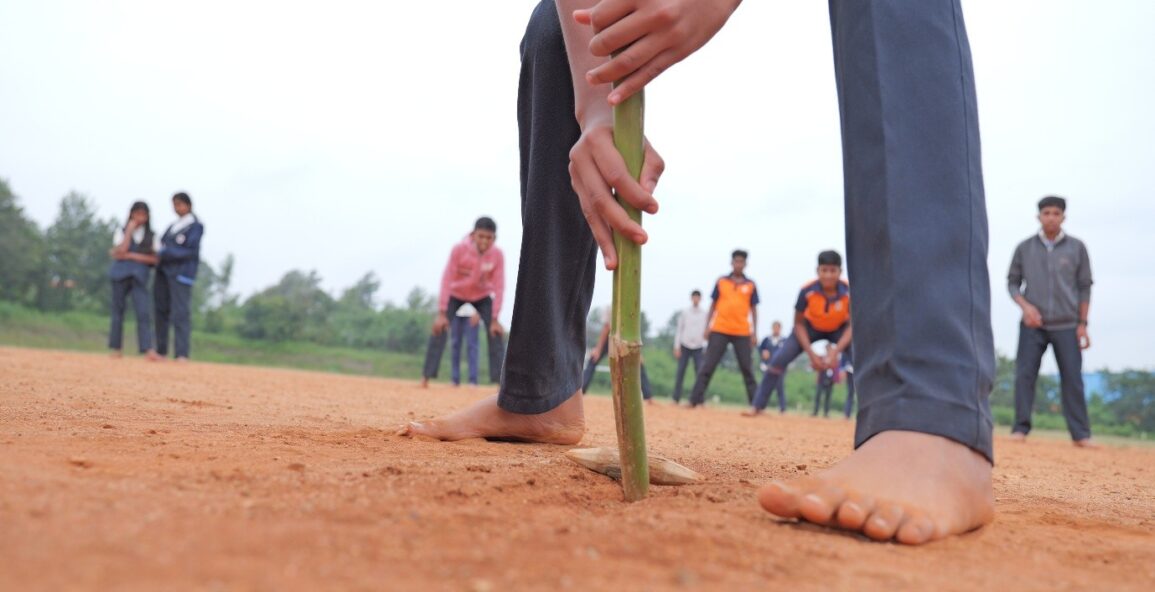
The athletic ground of Mathakondapalli Model School transformed into an open-air mathematics laboratory. Class VIII students experienced an unforgettable integration of Mathematics and Physical Education. The session brought textbook concepts to life through the traditional Indian game, demonstrating that #ExperientialLearning can make abstract mathematical ideas tangible and joyful.
When Play Met Pedagogy
The morning began with curious students gathering on the athletic ground, wondering how their mathematics lesson would unfold outdoors. Mr. Vishwa, the Physical Education teacher, opened the session with a demonstration of Gilli Danda, explaining the techniques of striking the small wooden gilli with the larger danda. Students watched intently as he demonstrated proper grip, stance, and the striking motion that sends the gilli soaring across the field, embodying the principles of #NEP2020 that emphasize holistic and integrated learning approaches.
Ms. Vennila, the Mathematics teacher, then bridged the game to mathematical concepts, pointing out that every strike involved angles, every flight path covered measurable distance, and every attempt represented probability in action. “Today, you’re not just playing,” she announced, “you’re becoming mathematical observers and analysts through #HandsOnLearning.”
The Learning Structure
Students divided into eight teams of 5-6 members each, with every team receiving gilli-danda sets, measuring tapes, protractors, and structured recording sheets. The activity followed a carefully designed rotation system where teams explored three interconnected mathematical concepts over 45 minutes, perfectly aligning with #InterdisciplinaryEducation principles that break down subject silos.
Exploring Angles Through Action
The first station focused on angle analysis. Students positioned themselves as observers, watching their teammates strike the gilli while estimating and then measuring the angle between the danda and the ground. Using protractors, they recorded various strike angles and noted which angles produced the longest distances. The discovery was immediate and exciting angles between 30-40 degrees consistently sent the gilli farther than steeper or shallower angles. “I can actually see acute and obtuse angles now, not just in diagrams!” exclaimed one student, demonstrating how #KinestheticLearning creates lasting understanding.
Teams debated and discussed their findings, with some students arguing for 35 degrees while others insisted 40 degrees was optimal. These authentic mathematical disagreements required them to return to their data, calculate averages, and justify their conclusions with evidence, embodying #CriticalThinking skills essential for 21st-century learners.
Measuring Distance, Building Precision
The second rotation challenged students to measure the actual distances traveled by the gilli. Armed with measuring tapes, students carefully marked landing spots with chalk and measured from the strike point to where the gilli first touched ground. They recorded measurements in both meters and centimeters, converting between units and calculating team averages through #CollaborativeLearning.
The longest strike recorded was an impressive 18.5 meters, while the shortest was 4.2 meters. Students computed that their team average was 11.3 meters across ten strikes. The activity naturally introduced concepts of mean, median, and range without the need for formal definitions students were calculating these measures because they needed them to compare team performance and identify patterns in their data, perfectly demonstrating #ContextualLearning.
Understanding Probability Through Practice
The third station explored experimental probability through repeated trials. Each team member attempted to strike the gilli five times, recording successful hits versus misses in tally tables. Students then calculated their success rates, expressing them as fractions, decimals, and percentages. One team discovered they achieved 18 successful hits out of 30 total attempts, which they calculated as 18/30 or 60% success rate, making #DataLiteracy come alive.
The most revealing discovery came when students compared their first-round success rates with their later attempts. Many noticed their probability of success improved with practice—one student moved from 40% success (2 out of 5) to 80% success (4 out of 5) after adjusting his strike angle based on observation. This led to discussions about how probability isn’t just random chance but can be influenced by skill, strategy, and understanding of mathematical principles like angles and force, showcasing #InquiryBasedLearning in action.
Connecting Mathematics to Life
Throughout the activity, students made spontaneous connections that reflected deep engagement with #RealWorldMathematics. “This is exactly like when I play cricket—the bowling angle matters just like this!” observed one student. Another connected probability to video games: “So when a game shows ‘65% chance of success,’ it’s like our strike success rate!” These unprompted insights demonstrated that the activity achieved its goal of making mathematics relevant and meaningful through #CulturallyResponsiveTeaching, as Gilli Danda is deeply rooted in Indian tradition.
The mathematical vocabulary that students naturally used during the activity was remarkable. Terms like “acute angle,” “average distance,” “success rate,” and “experimental probability” flowed in casual conversation as students strategized and analyzed their performance. Mathematics had shifted from being a foreign language to being a useful tool for understanding and improving their game, embodying the #JoyfulLearning philosophy.
Teacher Observations and Student Growth
As teachers, we observed transformations that extended beyond mathematical understanding. Students who typically remained quiet during regular mathematics lessons became animated discussants, arguing about optimal angles with evidence from their data. Those who usually rushed through calculations took time to ensure accurate measurements because precision mattered it affected their team’s performance and strategy, demonstrating genuine #StudentEngagement.
The collaboration within teams was particularly noteworthy. Students naturally divided responsibilities based on strengths some excelled at striking, others at measuring, some at recording data accurately, and others at analyzing patterns. They learned that mathematical work, like all meaningful work, benefits from diverse skills and perspectives, reflecting #TeamworkSkills essential for future success.
Physical coordination improved visibly throughout the session. Early attempts at striking the gilli were often awkward and unsuccessful, but students adjusted their technique based on both physical feedback and mathematical analysis. They were literally embodying the connection between mind and body, between theory and practice, demonstrating #HolisticDevelopment as envisioned by NEP 2020.
Looking Forward
The “Math in Motion” activity concluded with enthusiastic requests: “Can we do this again?” “Can we explore geometry through kabaddi next?” “Could we measure probability in our basketball games?” These questions revealed that we had succeeded in sparking curiosity and demonstrating that mathematics exists everywhere, waiting to be discovered through #ActiveLearning.
Students left the athletic ground that day with grass-stained uniforms, sun-warmed faces, and importantly, a transformed relationship with mathematics. They experienced firsthand that learning can be joyful, that mathematics is not confined to textbooks, and that their cultural heritage contains rich opportunities for academic exploration. This is the essence of #TransformativeEducation when students don’t just learn concepts but discover new ways of seeing and understanding their world.
The integration of Mathematics and Physical Education through Gilli Danda at Mathakondapalli Model School demonstrated that innovative pedagogy, cultural relevance, and joyful engagement can coexist with rigorous academic learning, creating experiences that students will remember and build upon throughout their educational journey.
R Gagana Sri
MM School