One of the most transformative shifts introduced by the National Education Policy (NEP) 2020 is the restoration of work, skills, and dignity of labour to the very heart of school education. For decades, learning in India remained largely textbook-driven and examination-centric. Today, that boundary is finally being broken. With the introduction of the National Curriculum Framework for School Education (NCF-SE) 2023, Vocational Education becomes a formal subject from Grade 6 not as an optional activity, but as a core academic discipline.
This marks a historic transformation in skill-based learning under NEP 2020. Learning is no longer restricted to notebooks and examinations. It now includes doing, building, observing, reflecting, collaborating, creating, and improving.
At Mathakondapalli Model School (MMS), we do not see this as a syllabus change alone. We see it as a deep educational shift in how children understand effort, work ethics, responsibility, respect, and real-world problem solving.
Why Skill-Based Education Begins in Middle School
Grades 6 to 8 form a crucial developmental stage for introducing vocational education from class 6. Students begin to shift from concrete learning to abstract reasoning, social awareness, logical decision-making, and identity formation. Introducing vocational education at this stage ensures that:
- Students connect theory with real-life application
- They understand the value of all professions
- They develop confidence through real work
- They learn teamwork, discipline, accountability, and reflection
- They understand that intelligence is not limited to written answers alone
This is not about producing workers at the age of 11. It is about producing capable learners, responsible citizens, and confident problem solvers through experiential learning in NEP 2020.
What Exactly Will Students Do in Grade 6?
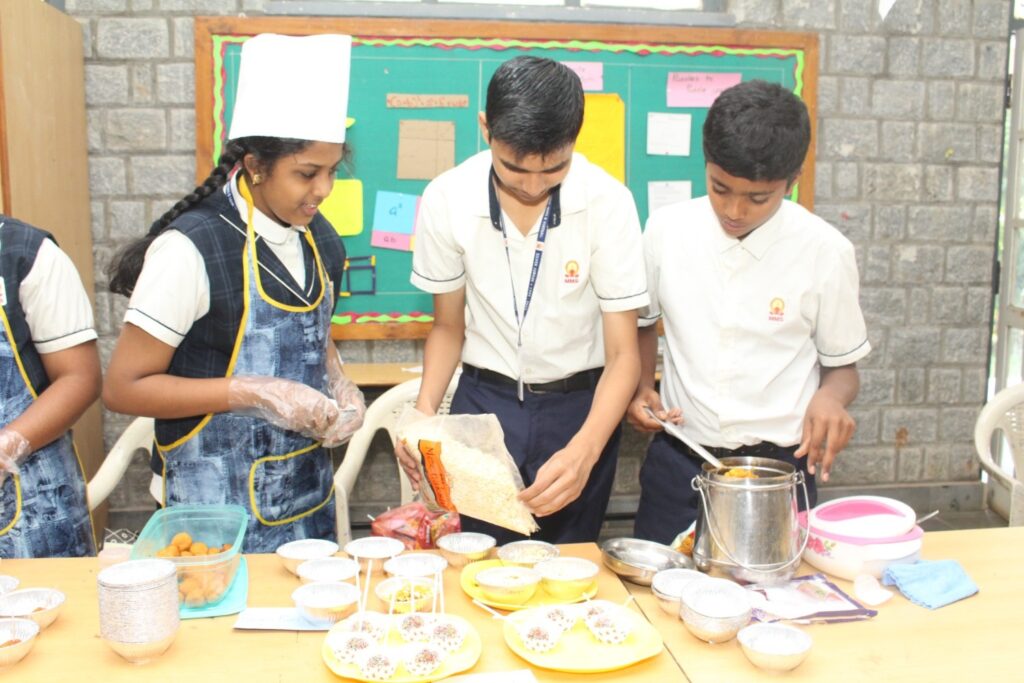
Every Grade 6 student will undertake projects across different “Forms of Work” during the academic year. Each project runs for approximately 30 hours, allowing:
- Trial and error
- Step-by-step task execution
- Safety practices
- Tool handling
- Documentation
- Reflection
- Redesign and improvement
Before projects begin, teachers ensure that relevant subject concepts from Science, Mathematics, Social Science, and Languages are already taught, so vocational education remains interdisciplinary and concept-driven, not isolated.
Students will learn to:
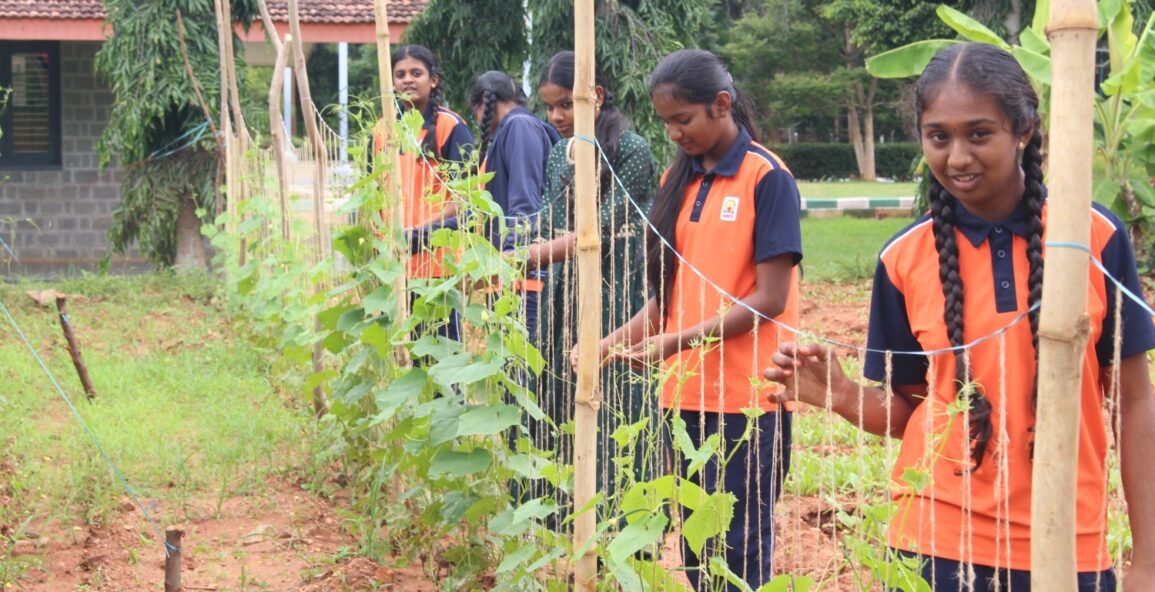
- Use real tools correctly and safely
- Break complex work into manageable steps
- Maintain quality and accuracy
- Collaborate in teams with individual responsibility
- Evaluate both process and outcome
- Apply classroom knowledge to daily life
More importantly, they will develop values such as initiative, persistence, discipline, empathy, creativity, sensitivity, and respect for physical labour as part of hands-on skill development.
Learning Beyond the Classroom: Community as Co-Educator
A defining strength of this framework is that learning extends beyond the school campus. Local farmers, artisans, mechanics, technicians, entrepreneurs, and professionals become co-educators through:
- Exposure visits
- Demonstration sessions
- Field observations
- Interaction workshops
- Skill exhibitions
Children begin to see how society functions through work not through theory alone. This creates social awareness, humility, respect, and career curiosity aligned with NEP 2020 vocational training goals.
Time Allocation: Depth Over Speed
Vocational Education is not treated as an occasional activity. As per NCF-SE 2023, 110 hours per academic year are exclusively allotted for vocational learning in Grade 6. These hours are carefully distributed to ensure deep engagement without academic overload.
Each project receives enough time for exploration, correction, and mastery ensuring learning is meaningful, not rushed, and supports competency-based education.
Assessment Without Fear: Skill Over Memorisation
NEP 2020 introduces a radical shift in assessment philosophy for middle school skill education. Students are no longer evaluated only through memory-based written tests. Instead, assessment focuses on how students learn, work, collaborate, document, reflect, and apply knowledge.
Official Weightage Structure for Vocational Assessment:
- Written Test – 10%
- Oral Presentation / Viva Voce – 30%
- Activity Book – 30%
- Student Portfolio – 10%
- Teacher’s Observation During Activities – 20%
This means 80% of the evaluation is based on practical learning, and only 20% on theory. Marks therefore reflect not just what a child remembers, but what a child can actually do.
Understanding Mark Deviations: A Parent Advisory
With competency-based evaluation in NEP 2020, parents must be aware that initial mark deviations are normal and temporary.
For years, students were rewarded mainly for memorisation. Under NEP, marks are distributed across process, performance, collaboration, application, and reflection. Therefore, three patterns may appear in the first one to two academic cycles:
- Temporary Dip (Earlier High Rote Scorers) Students who depended heavily on memorisation may initially face a slight drop as applied thinking gains importance.
- Steady Rise (Previously “Average” Learners) Students strong in creativity, teamwork, presentation, and practical thinking often show clear improvement.
- Stabilisation Phase (By Grades 7–8) With consistent exposure, most students achieve mark stability with stronger conceptual retention.
These deviations do not indicate decline in ability. They reflect a shift from memory-based ranking to ability-based ranking a far more honest academic system that addresses common parents’ concerns about NEP 2020 marks.
Why These Mark Deviations Are Academically Healthy
Mark fluctuations under NEP act as diagnostic indicators, not academic failures. They reveal:
- Difference between memory and understanding
- Strength in applied learning
- Teamwork ability
- Work discipline
- Emotional resilience
- Reflection capacity
In the long run, this prevents artificial mark inflation and makes board-level performance far more reliable and sustainable.
MMS Academic Safeguards for Mark Protection
At MMS, no student will suffer academically due to systemic transition. We have designed strong safeguards:
- Parallel concept reinforcement
- Bridge correction sessions
- Portfolio-based diagnostic tracking
- Early academic risk indexing
- Individualised learning support plans
- Parent academic transition briefings
This ensures that mark deviations become improvement signals not academic damage.
The Long-Term Advantage of Skill-Based Education
Research and global educational practice show that students exposed to skill-based learning demonstrate:
- Stronger board exam retention
- Higher problem-solving ability
- Better competitive exam adaptability
- Superior communication and presentation skills
- Greater career flexibility
While early adaptation may show mark movement, long-term academic performance becomes deeper, stronger, and more stable with NEP 2020 skill development benefits.
What MMS Is Preparing
At MMS, we are not implementing this reform mechanically. We are embedding it structurally and academically through:
- Interdisciplinary project frameworks
- Teacher training in vocational pedagogy
- Community professional partnerships
- Dedicated skill learning spaces
- Portfolio-based student growth tracking
- CBSE-aligned assessment rubrics
- Reflection-oriented classroom culture
Skill education at MMS is not an activity it is a life-preparation system.
A New Definition of an “Educated Child”
Under NEP 2020, an educated child is not merely one who scores high marks, but one who:
- Thinks critically
- Works responsibly
- Respects all professions
- Collaborates ethically
- Solves real-world problems
- Learns with confidence and humility
Skill-based learning from Grade 6 does not restrict career possibilities. On the contrary, it liberates children through competence, dignity, and life-readiness.
A Final Leadership Assurance to Parents
We state this with complete academic responsibility: “At MMS, innovation will never come at the cost of academic excellence. Skill-based education is being implemented with data-driven safeguards, evidence-based assessment, and personalised academic protection.” Parents must view temporary mark deviations not with fear, but with academic maturity. Education is no longer a race of short-term numbers it is the long-term formation of capability, character, and competence.
ERTD